

Some Open Pen Love (and Good Vibes All Round to Independent Publishers)
Share with me a little fawning over literary magazines and small presses.

The shameless bit
Firstly, let me get a few plugs out of the way. It’s a tad gauche, I know, to self promote, but seeing as it’s Open Pen, a magazine definitely worth your time and support, I’ll push through with the awkwardness.
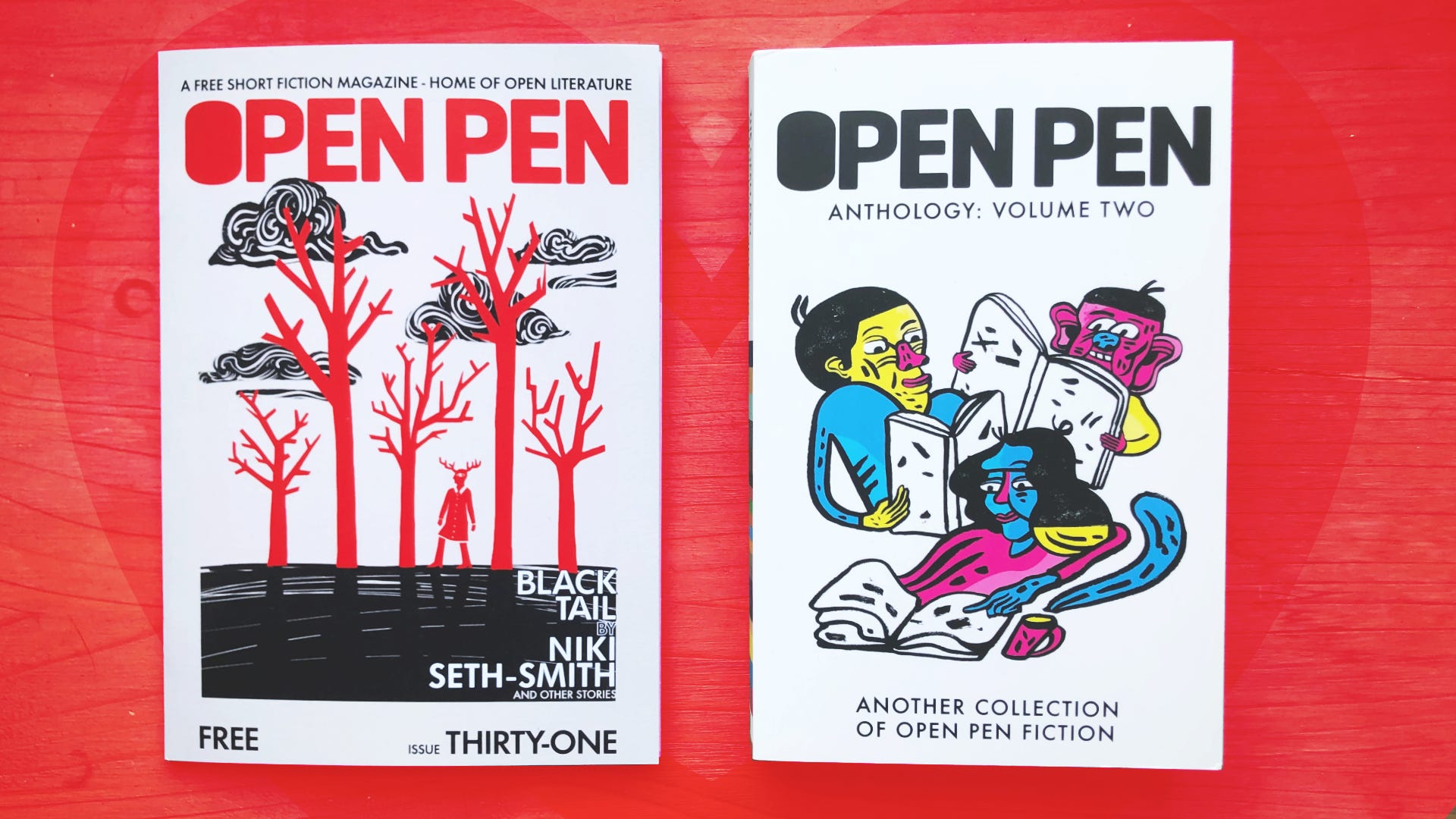
Issue Thirty-One is now out. Totally free—if you pop into one of the fine independent bookshops who stock it or, alternatively, for a modest and good-karmic fee, you can have it delivered to your door. Tidy.
I’ve contributed the editorial for this issue, ‘The Great Malaise’, which ponders literature’s place in a world becoming (or so we’re told) subsumed by Artificial Intelligence. The piece compares bland AI-generated content to the music of Coldplay, and suggests why the threat is less about abject fear and more in the numbness it engenders.
Also, Open Pen recently put out their second anthology, featuring both published fiction from over the last five years, and some brand-new yarns, too. I have a couple in there, ‘Remaining’, which appeared in issue twenty-seven, and ‘Fallen Fruit’. There are stories from the likes of Wendy Erskine, Rob True, Bonny Brooks, Mazin Saleem—too many really to list. Morgan Omotoye’s ‘In Case of Emergency, Break Glass’ is an absolute belter. (I’ve read it a few times now and, for me, it’s worth the price alone.)
It’s available most places, but Open Pen have a store (with several novelettes currently on sale), so, if piqued, why not get it direct?
The lovey-dovey bit
You may have noticed, here in 2026, the UK’s print magazine landscape, especially that of literary fiction, has all but vanished.
It has always been a niche industry, one kept thrumming along by a devoted (and quite possibly crazy) few, who do it not out of great fiscal ambition but rather some obscure calling. The whole thing’s a mystery.
Who are these strange people, these goody-two-shoe-types, and what motivates them? Why do they choose to spend their downtime reading hundreds of prospective stories1, communicating with writers—awful as we can be—and even dipping into their own pockets to fund the next print run?
Rising material and production costs post-Brexit have been the death-knell to many a small press2. This is dispiriting news for committed readers and writers alike, for it’s those smaller houses who operate outside the mainstream (if fiction could still be said to have a mainstream), that are the most willing to take risks. They publish stories that excite them, foremost, and not what fits latest trends or is liable to get TikTokers gesticulating.
I don’t, however, bring this up to wallow in what seems a constant shit-pile-on of those engaged in the literary sphere—or the creative sphere more broadly. I bring it up because I find it remarkable (and a smidge baffling) when an independent publisher manages to survive despite these and other pressures. What a meritorious feat it truly is.
It speaks to—or I believe is evidence to, in my more wistful, midnight rumination—a need for it. This could of course be projection; the vanity (maybe delusion) of somebody justifying countless hours spent staring at pencilled words on paper, imagining a point to it all.
But beyond this, or any narrow purview, those out there still championing people over novelty tech, in whichever space they occupy, deserve commendation. I don’t fully understand them, how they can be so beneficent (surely they must be atoning for something, right?). All the same, I wish these do-gooders well and hope they only continue to proliferate.
As the digital world becomes increasingly artificial, it’s comforting to know if we root further afield, outside the usual environs or even into the past, we still might chance upon something real.
Many of which won’t meet their submission criteria nor the magazine’s general vibe, and have been blindly sent by eager writers, confident an exceptional tale such as theirs warrants exceptions.